

The manufacturing industry is undergoing a profound digital transformation driven by connectivity, automation, and data intelligence. At the center of this evolution lies Industrial IoT (IIoT), a technology framework that enables industrial assets, machines, sensors, and software systems to communicate seamlessly and exchange real-time operational data.
As manufacturers face increasing pressure to improve productivity, reduce downtime, optimize maintenance costs, and enhance product quality, Industrial IoT (IIoT) has become a critical enabler of smart manufacturing initiatives. By connecting physical assets to digital platforms, organizations gain unprecedented visibility into operations, allowing engineers and maintenance professionals to make informed decisions based on actual equipment conditions rather than assumptions.
Today, Industrial IoT (IIoT) is no longer viewed as an emerging technology. It has become a strategic necessity for companies seeking operational excellence, sustainability, and competitive advantage in an increasingly connected industrial landscape.
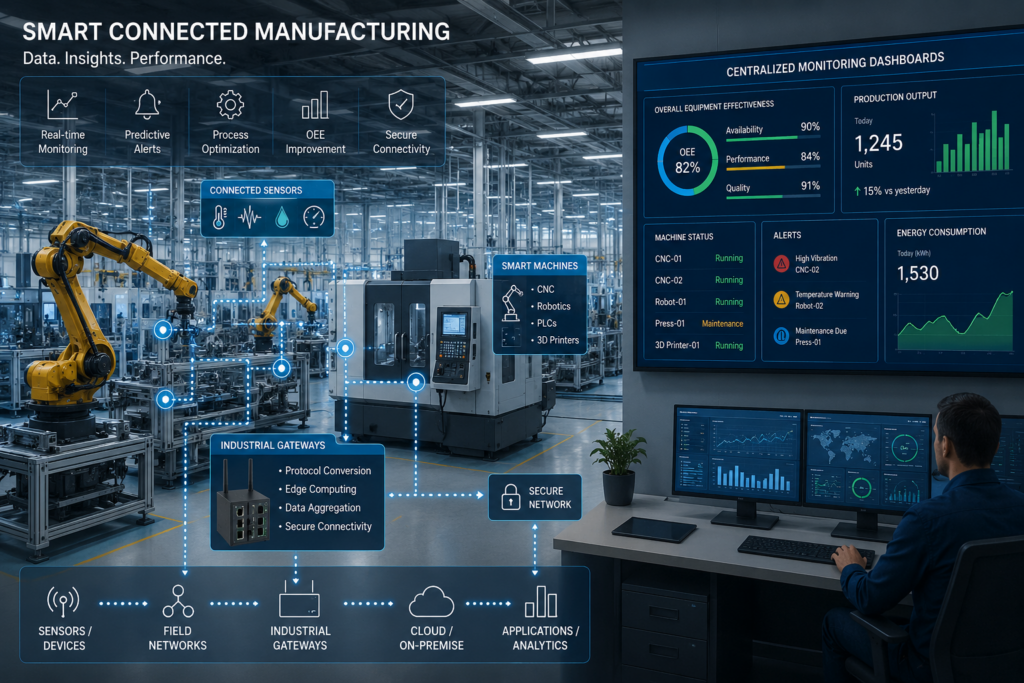
Industrial IoT architecture connecting smart manufacturing equipment and sensors.
Understanding Industrial IoT (IIoT)
Industrial IoT refers to the application of Internet of Things technologies within industrial environments such as manufacturing plants, power generation facilities, oil and gas operations, water treatment plants, mining sites, and logistics centers.
Unlike consumer IoT systems, which focus primarily on convenience and personal devices, Industrial IoT (IIoT) is designed to improve industrial processes, asset reliability, safety, and operational performance.
The fundamental concept involves connecting industrial assets through intelligent sensors and communication networks that continuously collect, transmit, and analyze operational data.
Typical IIoT-connected assets include:
- Electric motors
- Pumps
- Compressors
- Industrial robots
- Conveyor systems
- HVAC equipment
- Boilers
- Turbines
- Production lines
- Process instrumentation
This connectivity creates a digital ecosystem where machines become data-generating assets capable of providing valuable insights into their own performance and health.
Core Components of an Industrial IoT Architecture
Successful implementation of Industrial IoT (IIoT) depends on several interconnected technological layers.
Smart Sensors and Field Devices
Sensors serve as the foundation of every IIoT deployment.
These devices continuously monitor critical operating parameters such as:
- Temperature
- Vibration
- Pressure
- Flow rate
- Humidity
- Current consumption
- Voltage
- Rotational speed
Modern smart sensors often include onboard processing capabilities, enabling edge-level diagnostics before transmitting data to higher-level systems.
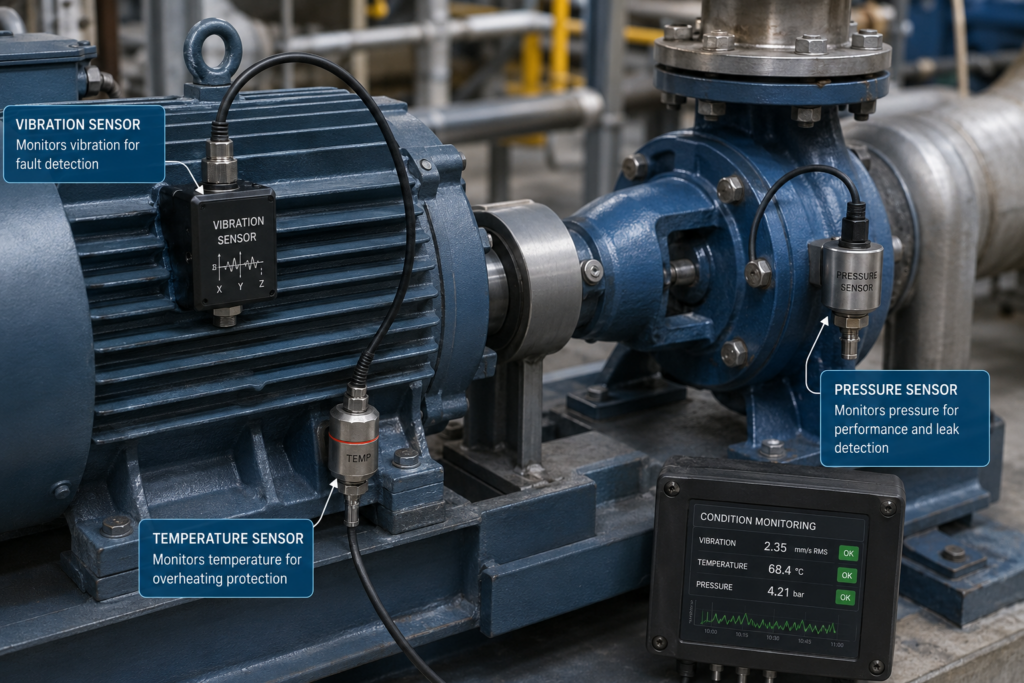
Smart industrial sensors monitoring machine health and performance.
Industrial Communication Networks
Data generated by field devices must be transmitted reliably and securely.
Common communication protocols include:
- Modbus TCP/IP
- PROFINET
- EtherNet/IP
- OPC UA
- MQTT
- WirelessHART
- LoRaWAN
The choice of protocol depends on factors such as bandwidth requirements, latency tolerance, security needs, and existing infrastructure.
Edge Computing
One challenge associated with IIoT systems is the massive volume of generated data.
Edge computing addresses this issue by processing data close to the source rather than transmitting all information to cloud servers.
Benefits include:
- Reduced network traffic
- Lower latency
- Faster response times
- Improved cybersecurity
- Enhanced system reliability
For critical industrial processes, edge computing often enables real-time decision-making without dependence on external networks.
Cloud Platforms
Cloud infrastructure provides scalable storage and computational resources for large-scale data analytics.
Cloud-based IIoT platforms allow organizations to:
- Store historical data
- Analyze equipment performance
- Generate predictive models
- Access information remotely
- Integrate multiple facilities into a centralized system
Cloud environments also facilitate collaboration among engineers, maintenance teams, and management personnel.
Analytics and Artificial Intelligence
Data alone provides limited value without proper analysis.
Advanced analytics platforms utilize:
- Machine learning
- Artificial intelligence
- Statistical modeling
- Pattern recognition
- Predictive algorithms
These technologies transform raw operational data into actionable insights that support maintenance and production decisions.
The Role of Industrial IoT in Smart Manufacturing
Smart manufacturing relies heavily on data-driven operations.
Industrial IoT (IIoT) acts as the digital backbone that connects equipment, personnel, and enterprise systems into a unified ecosystem.
Real-Time Operational Visibility
Traditional manufacturing environments often suffer from information silos.
Operators may only discover equipment problems after production losses occur.
IIoT eliminates these blind spots by providing real-time visibility into:
- Machine status
- Equipment utilization
- Production throughput
- Process efficiency
- Energy consumption
- Maintenance conditions
This transparency enables proactive operational management.
Predictive Maintenance
One of the most impactful applications of Industrial IoT (IIoT) is predictive maintenance.
Traditional maintenance strategies typically fall into two categories:
Reactive Maintenance
Equipment is repaired after failure occurs.
Drawbacks include:
- Unplanned downtime
- Production losses
- Emergency repair costs
- Increased safety risks
Preventive Maintenance
Maintenance is performed according to predefined schedules.
While more effective than reactive maintenance, preventive approaches often result in unnecessary interventions.
Predictive Maintenance with IIoT
IIoT systems continuously monitor asset conditions and identify anomalies before failures occur.
Engineers can monitor:
- Bearing wear
- Shaft misalignment
- Lubrication degradation
- Motor overheating
- Cavitation
- Electrical faults
As a result, maintenance activities are scheduled only when required, maximizing asset availability while reducing maintenance expenditures.
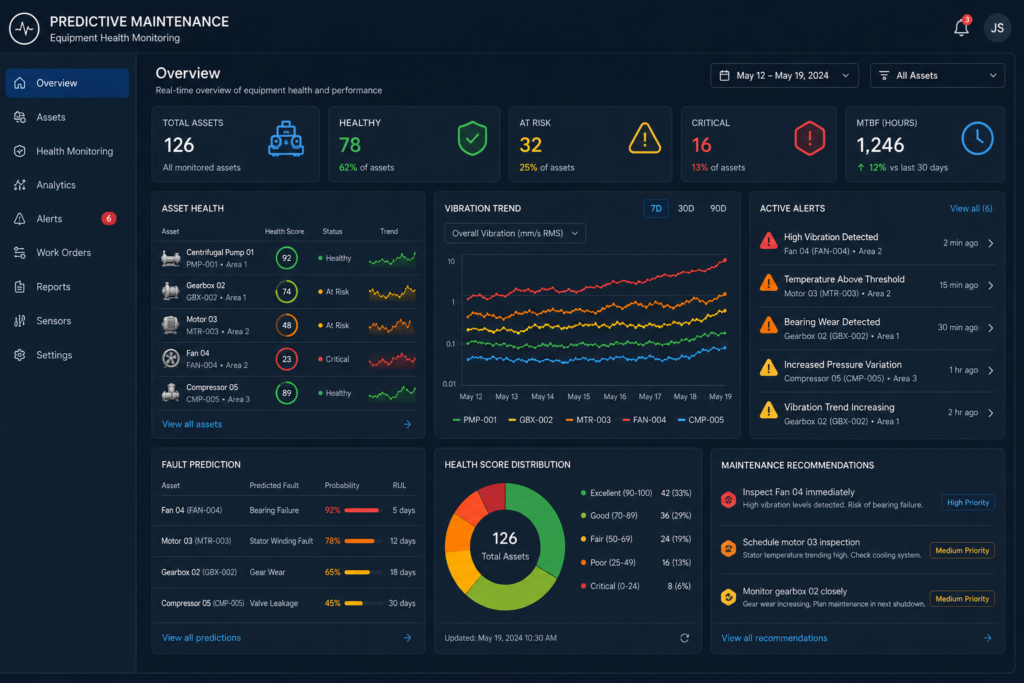
Predictive maintenance platform using Industrial IoT data analytics.
Industrial IoT and Asset Performance Management
Asset-intensive industries depend on reliable equipment operation.
IIoT significantly improves Asset Performance Management (APM) by enabling continuous condition monitoring.
Key performance indicators commonly monitored include:
- Mean Time Between Failures (MTBF)
- Mean Time To Repair (MTTR)
- Overall Equipment Effectiveness (OEE)
- Availability
- Reliability
- Energy Efficiency
Real-time monitoring allows maintenance teams to identify performance degradation long before catastrophic failure occurs.
Enhancing Operational Efficiency Through IIoT
Operational efficiency remains a primary objective for manufacturing organizations.
Industrial IoT (IIoT) supports efficiency improvements through several mechanisms.
Process Optimization
Continuous data collection helps identify:
- Production bottlenecks
- Equipment inefficiencies
- Process deviations
- Quality variations
Engineers can use this information to optimize operating parameters and improve production consistency.
Energy Management
Energy costs represent a significant portion of industrial operating expenses.
IIoT-based energy monitoring systems help organizations:
- Identify waste
- Monitor peak demand
- Detect abnormal consumption
- Optimize equipment loading
This leads to lower operational costs and improved sustainability.
Quality Improvement
Connected production systems enable real-time quality monitoring.
By correlating process parameters with product quality outcomes, manufacturers can:
- Reduce defects
- Minimize scrap
- Improve yield
- Increase customer satisfaction
Cybersecurity Considerations in Industrial IoT
While Industrial IoT (IIoT) offers substantial benefits, connectivity introduces cybersecurity challenges.
Industrial systems have become increasingly attractive targets for cyberattacks.
Potential threats include:
- Ransomware
- Data breaches
- Unauthorized access
- Process manipulation
- Industrial espionage
Best Practices for IIoT Security
Organizations should implement multiple layers of protection.
Recommended measures include:
Network Segmentation
Separate operational technology (OT) networks from corporate IT environments.
Strong Authentication
Implement multi-factor authentication for critical systems.
Encryption
Protect data during transmission and storage.
Continuous Monitoring
Monitor network activity for suspicious behavior.
Regular Updates
Keep firmware and software patched against known vulnerabilities.
A secure IIoT infrastructure is essential for maintaining operational continuity and protecting critical industrial assets.
Industrial IoT Integration with Existing Systems
Many manufacturing facilities already utilize automation technologies such as:
- PLCs
- SCADA systems
- DCS platforms
- MES software
- ERP systems
A major advantage of modern Industrial IoT (IIoT) platforms is their ability to integrate with existing infrastructure.
Rather than replacing legacy systems, IIoT solutions often enhance their capabilities by adding advanced analytics and connectivity features.
This approach reduces implementation costs while accelerating digital transformation initiatives.
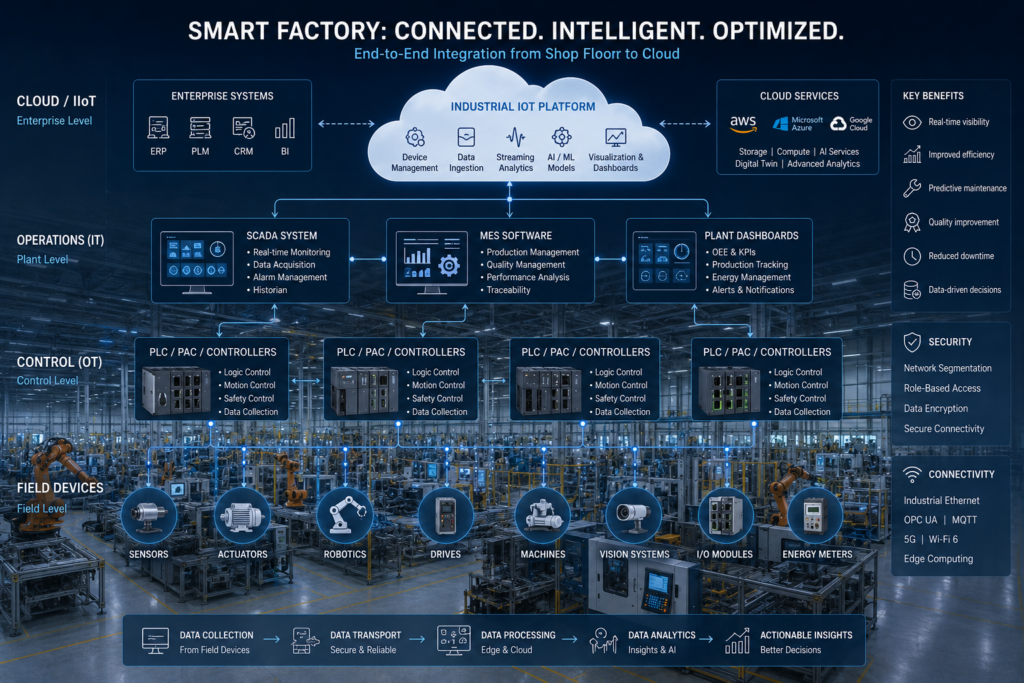
Industrial IoT integration with PLC, SCADA, MES, and enterprise systems.
Challenges of Industrial IoT Adoption
Despite its benefits, IIoT implementation is not without challenges.
Legacy Equipment Compatibility
Older assets may lack communication capabilities.
Retrofitting sensors and gateways is often necessary.
Data Management Complexity
Large-scale IIoT deployments generate enormous volumes of data.
Organizations must establish clear data governance strategies.
Workforce Skills Gap
Successful implementation requires expertise in:
- Industrial automation
- Networking
- Data science
- Cybersecurity
- Reliability engineering
Investing in workforce development is essential.
Initial Capital Investment
Although IIoT delivers long-term savings, upfront costs can be significant.
Organizations should focus on high-value use cases to achieve faster returns on investment.
Future Trends in Industrial IoT
The future of Industrial IoT (IIoT) continues to evolve rapidly.
Several emerging trends are expected to reshape industrial operations.
AI-Driven Autonomous Maintenance
Artificial intelligence will increasingly automate maintenance decision-making.
Digital Twins
Virtual representations of physical assets will become standard tools for optimization and simulation.
5G Industrial Connectivity
5G networks will support:
- Ultra-low latency
- High device density
- Enhanced reliability
Autonomous Manufacturing Systems
Factories will move toward self-optimizing production environments capable of adapting automatically to changing conditions.
Sustainability-Focused Operations
IIoT will play a major role in reducing:
- Carbon emissions
- Energy consumption
- Resource waste
This aligns with global sustainability objectives and regulatory requirements.
Conclusion
Industrial IoT (IIoT) has become the technological foundation of modern smart manufacturing. By connecting machines, sensors, control systems, and analytics platforms, organizations gain unprecedented visibility into operations and equipment performance.
For maintenance engineers, reliability professionals, and manufacturing leaders, IIoT provides the tools necessary to transition from reactive operations toward predictive and data-driven strategies. The result is improved asset reliability, reduced downtime, enhanced product quality, greater energy efficiency, and stronger competitiveness.
As digital transformation accelerates across industrial sectors, companies that embrace Industrial IoT (IIoT) will be better positioned to achieve operational excellence and long-term success.
Now is the time to evaluate your facility’s digital maturity, identify critical assets, and develop an Industrial IoT roadmap that supports future growth and resilience.
Frequently Asked Questions (FAQ)
What is the difference between IoT and Industrial IoT (IIoT)?
IoT generally refers to connected consumer devices, while Industrial IoT focuses on industrial assets, manufacturing systems, and operational technologies designed to improve reliability, efficiency, and productivity.
How does Industrial IoT support predictive maintenance?
IIoT continuously monitors equipment conditions through sensors and analytics platforms. By detecting anomalies early, maintenance teams can schedule interventions before failures occur.
What industries benefit most from Industrial IoT?
Industries that benefit significantly include:
- Manufacturing
- Oil and gas
- Power generation
- Mining
- Water treatment
- Chemical processing
- Logistics and warehousing
Is Industrial IoT suitable for legacy equipment?
Yes. Existing equipment can often be retrofitted with sensors, gateways, and monitoring devices, allowing organizations to implement IIoT without replacing major assets.
What are the biggest challenges of IIoT implementation?
The primary challenges include cybersecurity, integration with legacy systems, workforce training, data management, and initial investment costs.
Why is Industrial IoT considered the backbone of smart manufacturing?
Industrial IoT provides the connectivity, data collection, and analytics capabilities that enable real-time monitoring, predictive maintenance, process optimization, and intelligent decision-making throughout the manufacturing environment.