

Industrial automation has become the foundation of modern manufacturing, energy production, water treatment, oil and gas operations, and countless other industrial sectors. As facilities continue to embrace digital transformation and Industry 4.0 technologies, two automation technologies remain central to process control and operational efficiency: SCADA vs PLC Systems.
Many engineers, technicians, and maintenance professionals encounter these technologies daily, yet confusion often exists regarding their specific roles and differences. While both are essential components of industrial automation systems, they serve distinct purposes and work together to achieve reliable, efficient, and safe operation of industrial processes.
Understanding SCADA vs PLC Systems is critical for maintenance engineers, automation specialists, plant managers, and reliability professionals responsible for designing, operating, and maintaining automated facilities.
In this article, we will explore the architecture, functionality, advantages, limitations, and practical applications of SCADA and PLC systems while explaining how they complement each other within modern industrial environments.
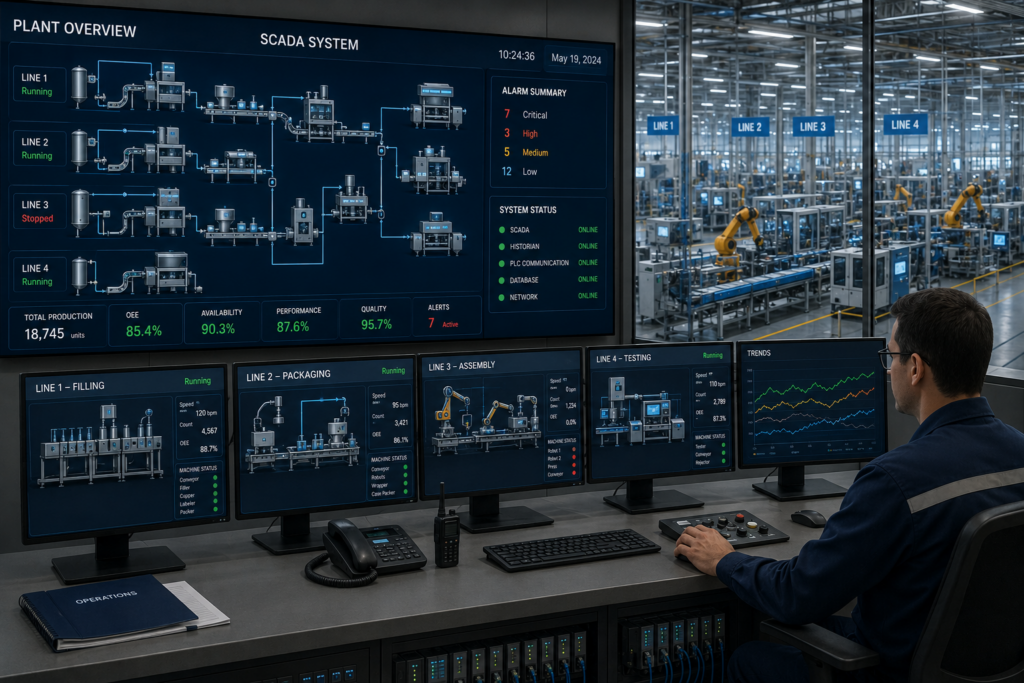
SCADA control room monitoring PLC-controlled industrial processes.
What Is a PLC?
A Programmable Logic Controller (PLC) is an industrial-grade computer specifically designed to control machines and processes in real time.
PLC systems receive input signals from sensors and field devices, execute programmed logic, and generate output signals that control actuators, motors, valves, relays, and other equipment.
Unlike conventional computers, PLCs are designed to withstand harsh industrial environments characterized by:
- Extreme temperatures
- Dust and contamination
- Electrical noise
- Mechanical vibration
- Humidity
- Continuous operation requirements
Because of their reliability and deterministic operation, PLCs have become the primary control devices in industrial automation.
Core Functions of a PLC
PLC systems perform several essential tasks:
- Reading sensor inputs
- Processing control logic
- Controlling outputs
- Executing sequencing operations
- Managing alarms
- Monitoring machine conditions
- Performing safety interlocks
PLC scan cycles occur in milliseconds, enabling extremely fast response times required for industrial control.
Main Components of a PLC System
Central Processing Unit (CPU)
The CPU serves as the brain of the PLC.
Its responsibilities include:
- Executing logic programs
- Processing input data
- Controlling outputs
- Managing communications
Input Modules
Input modules collect signals from field devices such as:
- Limit switches
- Pressure transmitters
- Proximity sensors
- Flow meters
- Temperature sensors
These signals are converted into data that the PLC can process.
Output Modules
Output modules transmit commands from the PLC to:
- Electric motors
- Solenoid valves
- Pumps
- Contactors
- Relays
- Industrial robots
Power Supply
The power supply provides stable operating voltage to the PLC hardware.
Communication Modules
Communication modules enable interaction with:
- SCADA systems
- HMIs
- Variable Frequency Drives (VFDs)
- Remote I/O stations
- Industrial networks
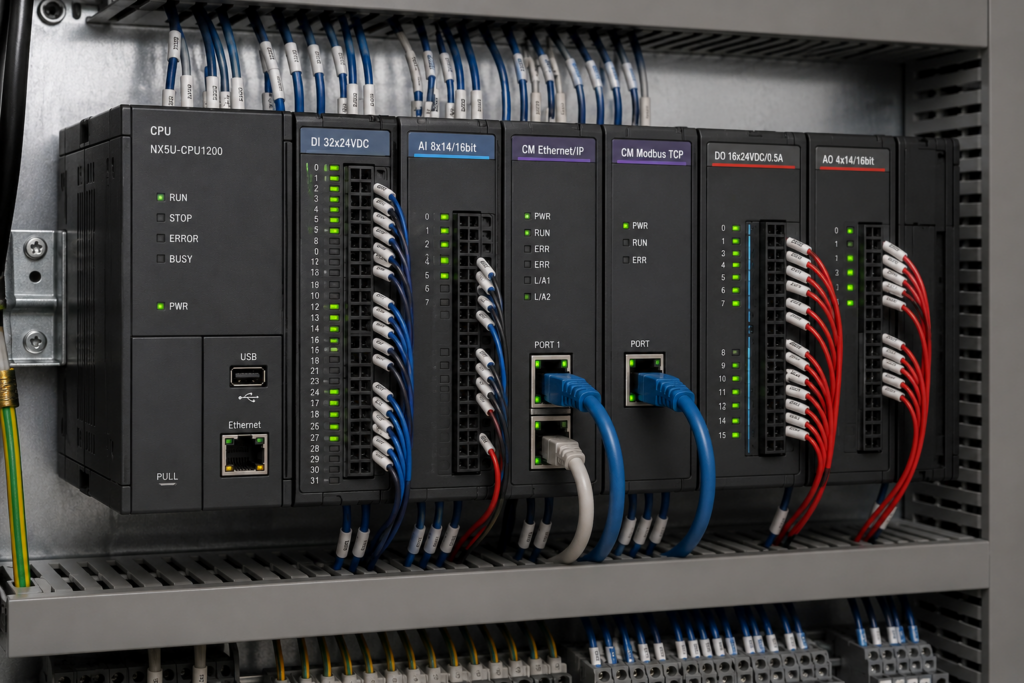
Industrial PLC hardware architecture inside a control panel.
What Is SCADA?
Supervisory Control and Data Acquisition (SCADA) is a software-based system used for monitoring, supervising, and controlling industrial processes from a centralized location.
While PLCs control equipment directly, SCADA systems provide operators and engineers with visibility into plant operations.
A SCADA platform collects data from PLCs and other field devices, then presents information through graphical interfaces, dashboards, reports, and alarms.
SCADA systems are commonly deployed in:
- Manufacturing plants
- Power stations
- Water treatment facilities
- Oil and gas pipelines
- Chemical processing plants
- Mining operations
The primary objective of SCADA is to provide operational awareness and centralized process supervision.
Main Components of a SCADA System
Human Machine Interface (HMI)
The HMI serves as the visual interface between operators and industrial processes.
Through the HMI, users can:
- Monitor equipment status
- View process trends
- Acknowledge alarms
- Start or stop equipment
- Modify operational parameters
SCADA Server
The SCADA server acts as the central processing platform.
Functions include:
- Data collection
- Alarm management
- Historical data storage
- Reporting
- Communication management
Historian Database
The historian stores operational data for long-term analysis.
Engineers use historical data to:
- Investigate failures
- Analyze trends
- Improve processes
- Support predictive maintenance
Communication Infrastructure
SCADA systems communicate with PLCs using industrial protocols such as:
- Modbus TCP
- OPC UA
- EtherNet/IP
- DNP3
- PROFINET
Remote Terminal Units (RTUs)
In geographically distributed systems, RTUs collect data from remote assets and transmit it to the SCADA system.
SCADA vs PLC Systems: Understanding the Key Difference
The most important distinction in the SCADA vs PLC Systems discussion is understanding their primary roles.
PLC = Control
A PLC directly controls industrial equipment.
Examples:
- Starting motors
- Opening valves
- Regulating conveyors
- Controlling robotic movements
PLCs make decisions in real time.
SCADA = Supervision
SCADA systems supervise and monitor operations.
Examples:
- Displaying equipment status
- Generating alarms
- Recording historical data
- Producing reports
SCADA provides visibility but typically does not perform high-speed control functions.
Simply put:
PLCs operate the process.
SCADA systems monitor the process.
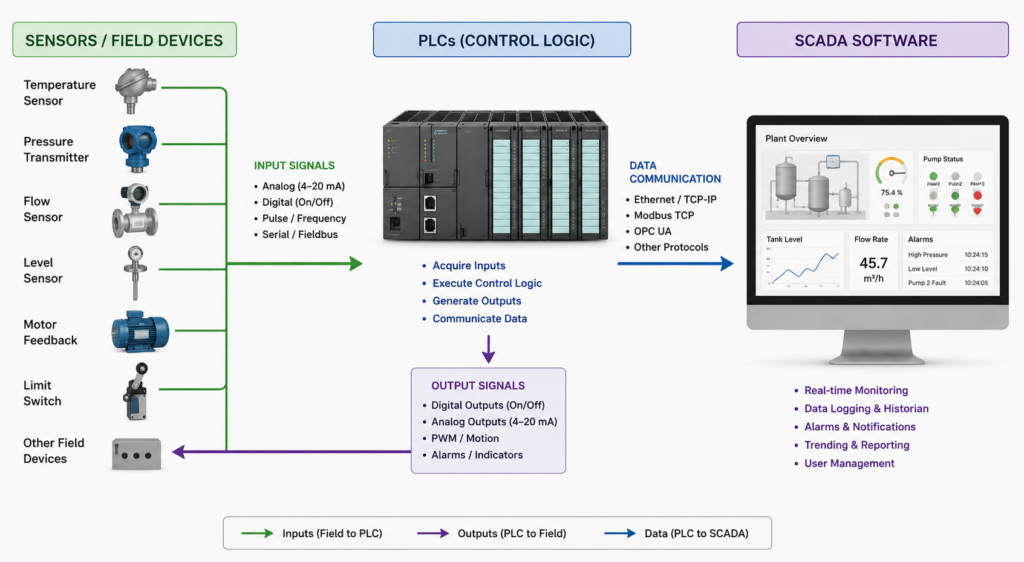
Relationship between PLC controllers and SCADA monitoring systems.
How SCADA and PLC Systems Work Together
In most industrial facilities, SCADA and PLC technologies are integrated.
A typical workflow follows these steps:
Step 1: Data Collection
Sensors measure:
- Temperature
- Pressure
- Flow
- Level
- Vibration
Step 2: PLC Processing
The PLC receives sensor inputs and executes control logic.
Examples:
- Starting a pump
- Stopping a motor
- Opening a control valve
Step 3: Data Transmission
The PLC sends operational data to the SCADA system.
Step 4: Visualization
SCADA displays real-time information to operators.
Step 5: Analysis
SCADA archives data for future analysis and reporting.
This architecture combines real-time control with centralized supervision.
Applications of PLC Systems
PLC technology is used across virtually every industrial sector.
Manufacturing
PLCs control:
- Assembly lines
- Packaging systems
- Conveyor networks
- Robotic cells
Water Treatment
Applications include:
- Pump control
- Chemical dosing
- Filtration systems
Oil and Gas
PLCs manage:
- Compressor stations
- Pipeline control
- Storage facilities
Power Generation
Typical functions:
- Turbine control
- Generator synchronization
- Fuel management
Food and Beverage
PLCs automate:
- Mixing processes
- Filling operations
- Packaging systems
Applications of SCADA Systems
SCADA systems excel in operations requiring centralized monitoring.
Utility Networks
SCADA monitors:
- Electrical grids
- Water distribution networks
- Wastewater systems
Oil and Gas Pipelines
Operators can supervise hundreds of kilometers of infrastructure from a central control room.
Manufacturing Facilities
SCADA provides:
- Production visibility
- Equipment status monitoring
- Performance reporting
Renewable Energy
SCADA is widely used in:
- Solar farms
- Wind farms
- Battery storage systems
Benefits of PLC Systems
Fast Response Time
PLC scan cycles occur in milliseconds.
This enables rapid control actions required for industrial automation.
High Reliability
PLCs are designed for continuous industrial operation.
Flexible Programming
Engineers can modify logic without replacing hardware.
Easy Integration
PLCs communicate easily with:
- SCADA platforms
- HMI systems
- VFDs
- IIoT platforms
Reduced Downtime
Automated control reduces operational interruptions.
Benefits of SCADA Systems
Centralized Monitoring
Operators gain complete visibility of plant operations.
Improved Decision-Making
Real-time data supports informed operational decisions.
Historical Data Analysis
Trend analysis helps optimize performance.
Alarm Management
SCADA immediately alerts personnel to abnormal conditions.
Enhanced Maintenance Planning
Maintenance teams can identify recurring equipment issues.
SCADA vs PLC Systems in Predictive Maintenance
One of the most valuable applications of modern automation is predictive maintenance.
PLC Contribution
PLCs collect real-time equipment data including:
- Vibration levels
- Motor current
- Temperature
- Pressure
SCADA Contribution
SCADA systems:
- Store historical data
- Generate trends
- Analyze performance changes
- Trigger maintenance alerts
Together, they enable proactive maintenance strategies that reduce unplanned downtime.
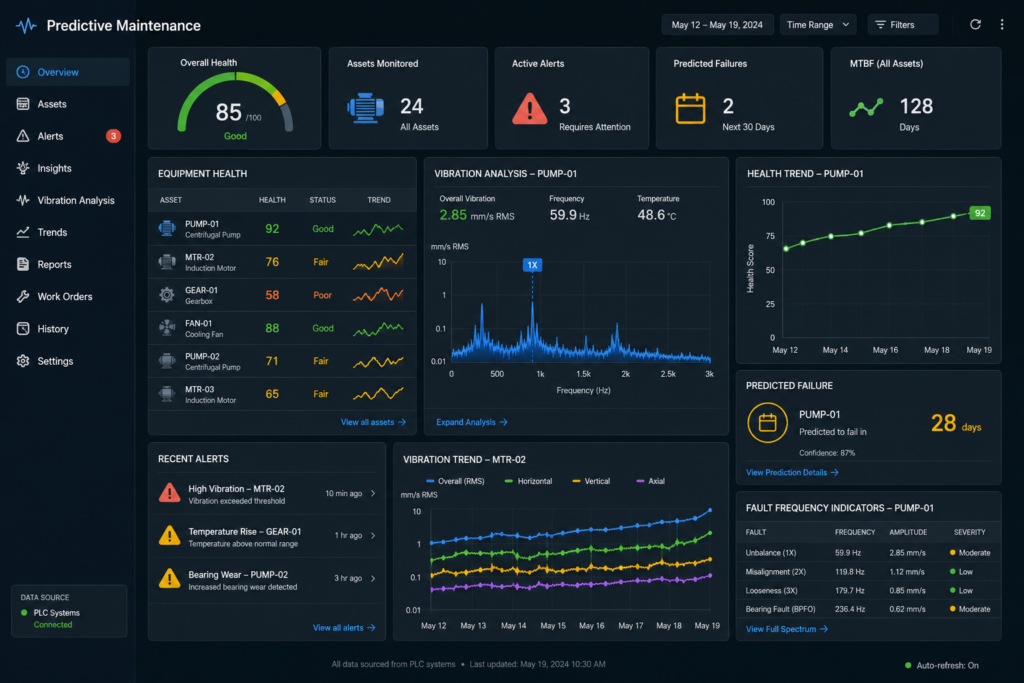
SCADA predictive maintenance dashboard using PLC-collected machine data.
Challenges of SCADA and PLC Implementation
Despite their benefits, implementation presents challenges.
Cybersecurity Risks
Connected systems face threats including:
- Malware
- Ransomware
- Unauthorized access
Mitigation strategies include:
- Network segmentation
- Firewalls
- Authentication controls
- Security audits
Integration Complexity
Legacy systems may require upgrades to support modern communications.
Workforce Skills
Successful implementation requires expertise in:
- Automation engineering
- Networking
- Cybersecurity
- Instrumentation
Initial Investment
Hardware, software, and engineering costs can be significant.
However, long-term productivity gains often justify the investment.
Future Trends in SCADA and PLC Technologies
Industrial automation continues evolving rapidly.
Industrial IoT Integration
Modern PLCs increasingly connect directly to IIoT platforms.
Cloud-Based SCADA
Cloud technologies enable remote monitoring and analytics.
AI-Driven Automation
Artificial intelligence is enhancing decision support capabilities.
Edge Computing
Processing data closer to equipment improves responsiveness.
Digital Twin Integration
Virtual models are increasingly linked with PLC and SCADA systems.
These developments will further improve reliability, efficiency, and operational visibility.
Best Practices for Engineers and Maintenance Teams
To maximize the value of SCADA and PLC technologies:
- Standardize automation architecture.
- Implement strong cybersecurity policies.
- Maintain accurate documentation.
- Train personnel regularly.
- Monitor system performance continuously.
- Integrate predictive maintenance strategies.
- Perform routine software backups.
These practices help ensure long-term system reliability and operational excellence.
Conclusion
The debate surrounding SCADA vs PLC Systems often stems from a misunderstanding of their distinct functions. In reality, they are not competing technologies but complementary components of a modern industrial automation architecture.
PLCs provide the real-time control necessary to operate equipment safely and efficiently, while SCADA systems deliver the visibility, monitoring, reporting, and supervisory capabilities required for effective plant management.
Together, they form the backbone of industrial automation, enabling organizations to improve productivity, reduce downtime, enhance maintenance performance, and support digital transformation initiatives.
As Industry 4.0 technologies continue to advance, engineers who understand the relationship between SCADA and PLC systems will be better equipped to design, maintain, and optimize the intelligent factories of the future.
Ready to modernize your automation infrastructure? Evaluate your current control architecture, identify performance gaps, and build a roadmap that leverages both PLC and SCADA technologies for maximum operational efficiency.
Frequently Asked Questions (FAQ)
What is the main difference between SCADA and PLC systems?
A PLC performs real-time control of equipment, while a SCADA system provides monitoring, supervision, visualization, and historical data analysis.
Can a PLC work without SCADA?
Yes. PLCs can operate independently and control machines without a SCADA system. However, operators lose centralized monitoring and reporting capabilities.
Does SCADA replace a PLC?
No. SCADA does not replace PLCs. It complements them by providing supervisory functions and process visibility.
Which is more important: SCADA or PLC?
Both are important because they perform different functions. PLCs control processes, while SCADA systems monitor and manage them.
How do PLCs communicate with SCADA systems?
Common communication protocols include Modbus TCP, OPC UA, EtherNet/IP, PROFINET, and DNP3.
Why are SCADA and PLC systems essential for predictive maintenance?
PLCs collect operational data from equipment, while SCADA stores and analyzes that data to identify trends, detect anomalies, and support predictive maintenance strategies.