

In today’s highly competitive manufacturing landscape, organizations face constant pressure to increase production output, improve quality, reduce operational costs, and maintain maximum equipment availability. Traditional manufacturing methods, heavily dependent on manual labor and reactive maintenance practices, often struggle to meet these evolving demands.
As a result, Industrial Robotics and Automation have become critical technologies driving modern manufacturing excellence. From automotive assembly lines and food processing facilities to pharmaceutical plants and logistics centers, robotic systems are transforming industrial operations by performing tasks faster, more accurately, and more consistently than ever before.
The adoption of Industrial Robotics and Automation is no longer limited to large multinational corporations. Advances in robotics, artificial intelligence, machine vision, Industrial Internet of Things (IIoT), and collaborative robots have made automation accessible to organizations of all sizes.
For maintenance engineers, reliability specialists, automation professionals, and plant managers, understanding the capabilities and benefits of Industrial Robotics and Automation is essential for achieving operational excellence while minimizing downtime and maximizing asset performance.
[Image: Modern manufacturing facility utilizing multiple robotic arms, automated conveyors, and digital control systems operating in a smart factory environment – Credit: Smart Manufacturing Solutions]
Alt Text: Industrial robots operating in a fully automated smart manufacturing facility.
Understanding Industrial Robotics and Automation
Industrial Robotics and Automation refers to the use of programmable robotic systems, automated machinery, intelligent control technologies, and digital communication networks to perform industrial tasks with minimal human intervention.
Automation systems are designed to execute repetitive, hazardous, precise, or labor-intensive operations while maintaining consistent quality and high productivity levels.
Industrial robots can perform a wide variety of tasks, including:
- Welding
- Painting
- Assembly
- Packaging
- Palletizing
- Machine tending
- Material handling
- Inspection
- Sorting
- Quality control
Modern automation solutions integrate robotics with:
- PLC systems
- SCADA platforms
- Industrial IoT devices
- Artificial Intelligence
- Machine Vision Systems
- Predictive Maintenance Platforms
- Cloud Analytics
Together, these technologies create highly efficient and intelligent manufacturing environments.
The Evolution of Industrial Robotics
The history of industrial robotics dates back to the early 1960s when the first programmable robotic arms were introduced into automotive manufacturing.
First Generation Robots
Early robots performed simple repetitive motions.
Characteristics included:
- Fixed programming
- Limited flexibility
- Basic control systems
- Minimal sensing capabilities
Second Generation Robots
Advancements introduced:
- Sensors
- Feedback systems
- Improved accuracy
- Enhanced reliability
Third Generation Robots
Modern robotic systems now incorporate:
- Artificial Intelligence
- Machine Learning
- Vision Systems
- Autonomous Decision-Making
- Advanced Motion Control
Today’s robots can adapt to changing production requirements while continuously optimizing performance.
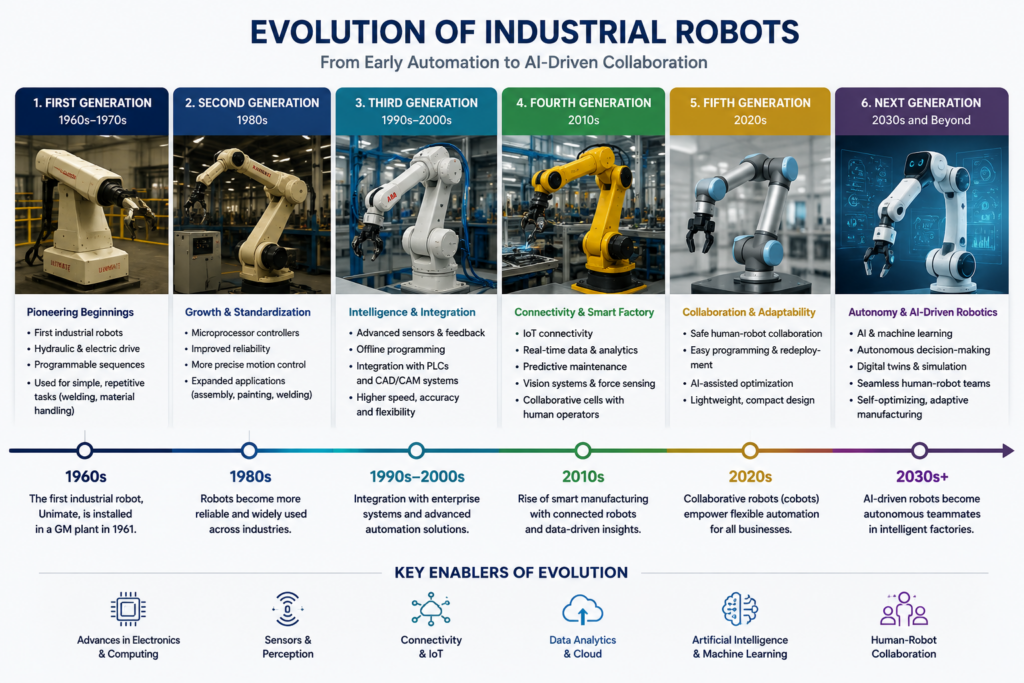
Evolution of industrial robotics technologies from traditional automation to AI-powered systems.
Key Components of Industrial Robotic Systems
Understanding robotic architecture helps engineers optimize maintenance and operational performance.
Robotic Manipulator
The manipulator represents the physical robotic arm.
It consists of:
- Joints
- Links
- Actuators
- End effectors
The manipulator performs the actual movement required for industrial tasks.
Controller
The controller functions as the robot’s brain.
Responsibilities include:
- Motion calculations
- Program execution
- Communication management
- Safety monitoring
End Effectors
End effectors interact directly with products and materials.
Examples include:
- Grippers
- Welding torches
- Vacuum cups
- Cutting tools
- Spray guns
Sensors
Sensors provide environmental awareness.
Common sensors include:
- Vision sensors
- Force sensors
- Position sensors
- Proximity sensors
- Laser scanners
Communication Networks
Modern robotic systems communicate through:
- PROFINET
- EtherNet/IP
- OPC UA
- Modbus TCP
- Industrial Ethernet
Types of Industrial Robots
Different industrial applications require different robotic configurations.
Articulated Robots
Articulated robots are the most widely used industrial robots.
Applications include:
- Welding
- Assembly
- Material handling
- Packaging
Advantages:
- High flexibility
- Wide range of motion
- Excellent precision
SCARA Robots
SCARA robots excel in high-speed assembly operations.
Common uses:
- Electronics manufacturing
- Pick-and-place applications
- Packaging operations
Cartesian Robots
Cartesian robots move along linear axes.
Applications include:
- CNC machine loading
- Material transport
- Precision assembly
Delta Robots
Delta robots provide exceptional speed.
Common applications:
- Food packaging
- Pharmaceutical processing
- Sorting systems
Collaborative Robots (Cobots)
Cobots are designed to work safely alongside human operators.
Benefits include:
- Easy deployment
- Lower investment costs
- Flexible operation
- Improved workforce productivity
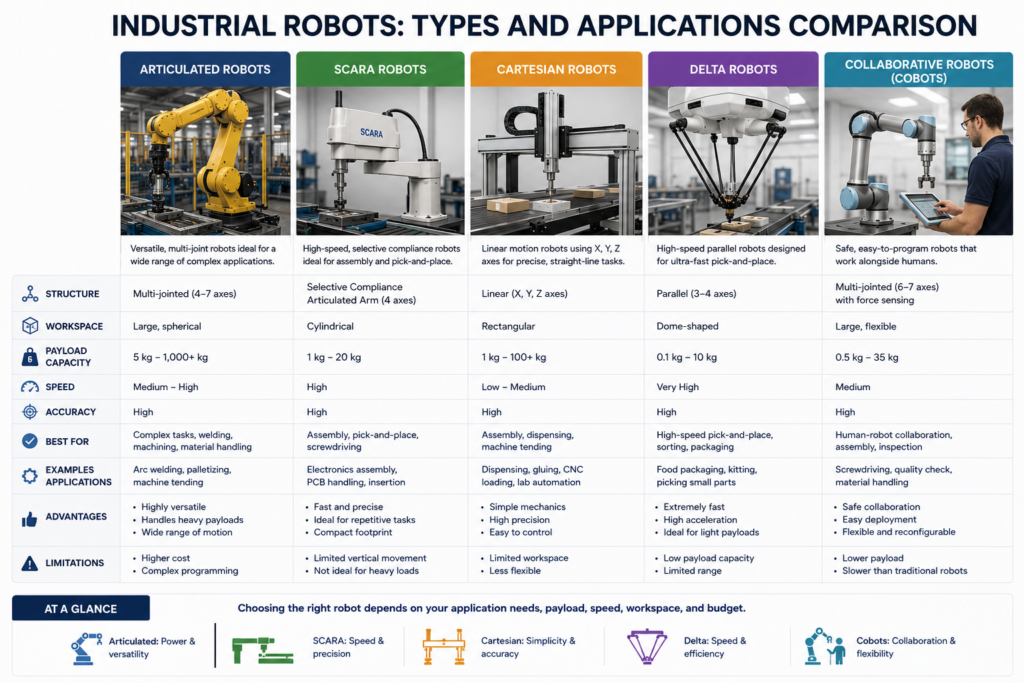
Various industrial robot configurations used in manufacturing automation.
How Industrial Robotics Increase Productivity
One of the primary reasons organizations invest in Industrial Robotics and Automation is productivity improvement.
Continuous Operation
Unlike human workers, robots can operate:
- 24 hours per day
- 7 days per week
- With minimal interruptions
This dramatically increases production output.
Faster Cycle Times
Robots execute repetitive tasks with consistent speed.
Benefits include:
- Higher throughput
- Reduced bottlenecks
- Faster order fulfillment
Improved Accuracy
Human error can result in defects and production losses.
Robots maintain:
- Consistent positioning
- Precise movement
- Repeatable performance
This improves product quality and reduces waste.
Scalability
Automation systems can be expanded to accommodate increasing production demands.
Organizations can scale operations without proportionally increasing labor costs.
Industrial Robotics and Downtime Reduction
Reducing downtime remains a major objective for maintenance departments.
Unexpected equipment failures often result in:
- Lost production
- Increased maintenance costs
- Delayed deliveries
- Customer dissatisfaction
Industrial Robotics and Automation help minimize downtime through several mechanisms.
Predictive Maintenance Integration
Modern robotic systems continuously generate operational data.
Parameters monitored include:
- Motor temperatures
- Vibration levels
- Current consumption
- Gearbox performance
- Cycle counts
Maintenance teams can identify abnormalities before failures occur.
Condition Monitoring
Integrated sensors provide real-time health monitoring.
Benefits include:
- Early fault detection
- Reduced catastrophic failures
- Improved maintenance planning
Automated Diagnostics
Advanced robotic controllers perform self-diagnostic functions.
They can identify:
- Servo motor issues
- Communication failures
- Mechanical wear
- Positioning errors
This significantly reduces troubleshooting time.
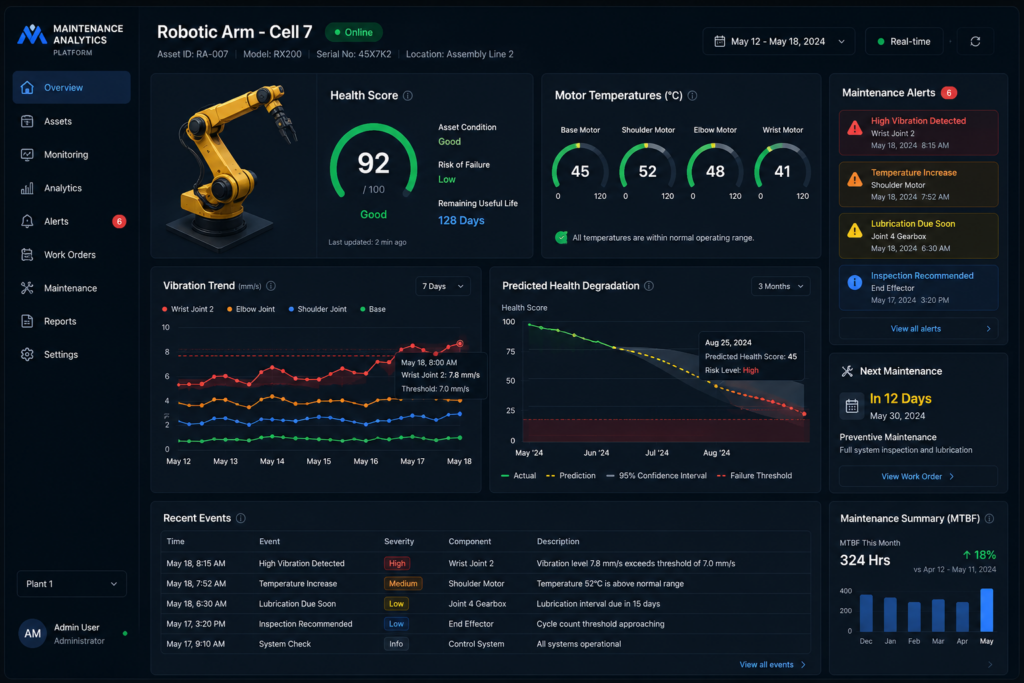
Predictive maintenance system monitoring industrial robotic equipment.
Industrial Robotics and Quality Improvement
Quality control is a critical factor in manufacturing competitiveness.
Robotic automation improves quality through:
Consistent Performance
Every production cycle is executed identically.
Benefits include:
- Reduced variability
- Improved product consistency
- Lower rejection rates
Vision-Based Inspection
Machine vision systems enable automated quality control.
Capabilities include:
- Defect detection
- Dimensional verification
- Surface inspection
- Barcode validation
Precision Manufacturing
Robotic systems achieve accuracy levels beyond human capability.
Applications include:
- Semiconductor manufacturing
- Medical device production
- Aerospace assembly
Applications of Industrial Robotics Across Industries
Automotive Manufacturing
The automotive industry remains the largest user of industrial robots.
Applications include:
- Spot welding
- Painting
- Assembly
- Material handling
Food and Beverage
Robots improve hygiene and efficiency.
Common tasks:
- Packaging
- Sorting
- Palletizing
- Product inspection
Pharmaceutical Manufacturing
Robotic automation supports:
- Sterile production
- Packaging
- Inspection
- Laboratory automation
Oil and Gas
Industrial robots perform:
- Pipeline inspection
- Tank inspection
- Hazardous environment operations
Logistics and Warehousing
Warehouse automation includes:
- Automated guided vehicles (AGVs)
- Robotic picking systems
- Automated storage solutions
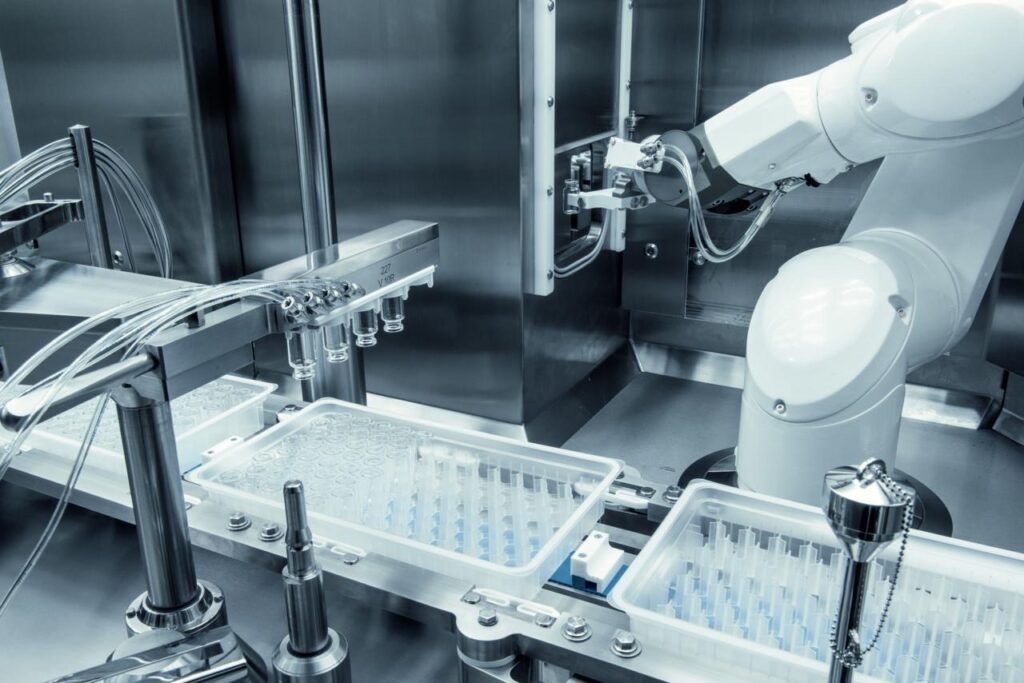
Industrial robotics applications across multiple manufacturing sectors.
The Role of Artificial Intelligence in Industrial Robotics
Artificial Intelligence is transforming robotic capabilities.
AI enables robots to:
- Learn from data
- Adapt to changes
- Improve performance
- Make intelligent decisions
Machine Learning
Machine learning algorithms help robots optimize:
- Motion paths
- Energy consumption
- Process parameters
Computer Vision
AI-powered vision systems support:
- Object recognition
- Defect identification
- Autonomous navigation
Autonomous Operations
Future robotic systems will increasingly operate with minimal human supervision.
Industrial Robotics and Industry 4.0
Industry 4.0 relies heavily on connected automation technologies.
Industrial Robotics and Automation serve as key enablers of smart manufacturing.
Integration with Industry 4.0 technologies includes:
Industrial IoT (IIoT)
Robots continuously exchange operational data.
Cloud Computing
Cloud platforms support:
- Data storage
- Analytics
- Remote monitoring
Digital Twins
Digital twins create virtual models of robotic systems.
Benefits include:
- Performance simulation
- Failure prediction
- Process optimization
Edge Computing
Edge processing enables faster decision-making and reduced latency.
Challenges of Industrial Robotics Implementation
Despite numerous advantages, implementation presents challenges.
High Initial Investment
Costs include:
- Robot hardware
- Integration services
- Software platforms
- Training programs
Workforce Adaptation
Employees require training in:
- Robot programming
- Maintenance procedures
- Automation systems
Cybersecurity Risks
Connected robotic systems require strong security measures.
Recommended practices:
- Network segmentation
- Secure communications
- Access control systems
Maintenance Requirements
Robots require:
- Calibration
- Lubrication
- Component inspections
- Software updates
Proper maintenance is essential for maximizing ROI.
Best Practices for Robotic Maintenance
Maintenance professionals should implement structured maintenance programs.
Preventive Maintenance
Routine inspections should include:
- Lubrication checks
- Cable inspections
- Fastener verification
- Sensor calibration
Predictive Maintenance
Use condition monitoring technologies to detect:
- Bearing wear
- Servo motor degradation
- Gearbox failures
Spare Parts Management
Maintain inventory of critical components.
Examples:
- Servo drives
- Controllers
- Sensors
- Communication modules
Continuous Training
Automation technologies evolve rapidly.
Regular training ensures maintenance teams remain technically competent.
Future Trends in Industrial Robotics and Automation
The future of Industrial Robotics and Automation is being shaped by several emerging technologies.
AI-Powered Robots
Future robots will become increasingly autonomous.
Human-Robot Collaboration
Cobots will expand across manufacturing sectors.
Mobile Robotics
Autonomous mobile robots will improve internal logistics.
Digital Twin Integration
Virtual simulations will enhance reliability engineering.
Sustainable Automation
Robots will support:
- Energy efficiency
- Waste reduction
- Sustainable manufacturing practices
Organizations adopting these innovations will gain significant competitive advantages.
Conclusion
Industrial Robotics and Automation have become essential technologies for modern manufacturers seeking higher productivity, improved quality, and reduced downtime. Through advanced robotics, intelligent control systems, predictive maintenance, and Industry 4.0 integration, organizations can transform operations and achieve unprecedented levels of efficiency.
For maintenance engineers and automation professionals, robotic technologies provide powerful tools for enhancing asset reliability, optimizing maintenance strategies, and supporting continuous improvement initiatives.
As manufacturing continues to evolve toward fully connected smart factories, organizations that invest strategically in Industrial Robotics and Automation will be better positioned to meet future production demands, reduce operational costs, and maintain a sustainable competitive edge.
Ready to modernize your facility? Begin by evaluating automation opportunities, identifying high-impact processes, and developing a robotics implementation roadmap that aligns with your operational goals and long-term digital transformation strategy.
Frequently Asked Questions (FAQ)
What is the difference between industrial robotics and industrial automation?
Industrial robotics focuses on programmable robotic machines, while industrial automation encompasses a broader range of technologies including PLCs, SCADA systems, robotics, sensors, and intelligent control systems.
How do industrial robots reduce downtime?
Industrial robots support predictive maintenance, automated diagnostics, condition monitoring, and consistent operation, helping prevent unexpected failures and reducing production interruptions.
Which industries benefit most from industrial robotics?
Major beneficiaries include automotive, food and beverage, pharmaceuticals, electronics, logistics, aerospace, and oil and gas industries.
Are collaborative robots safer than traditional robots?
Yes. Collaborative robots are specifically designed to operate safely alongside human workers using advanced sensors and safety features.
What maintenance do industrial robots require?
Regular maintenance includes lubrication, calibration, sensor inspection, software updates, cable checks, and condition monitoring.
How does Industry 4.0 impact industrial robotics?
Industry 4.0 enhances robotics through connectivity, IIoT integration, cloud analytics, artificial intelligence, digital twins, and real-time performance monitoring.
What is the ROI of industrial robotics?
ROI depends on application and industry, but benefits typically include higher productivity, lower labor costs, improved quality, reduced downtime, and enhanced operational efficiency.